How to write AI Prompts: 7 Powerful Tips to Master Prompt Engineering

ai prompts: 3D isometric illustration of a person at a desk with a holographic screen showing a prompt box and emerging 3D elements: a dog, chart, and storybook.
Master the art of Prompt Engineering with these 7 essential strategies. Learn how to provide context, define structure, and iterate your way to perfect AI-generated content. Stop guessing and start directing.

Generative AI: 5 Top Ways AI Creates New Content

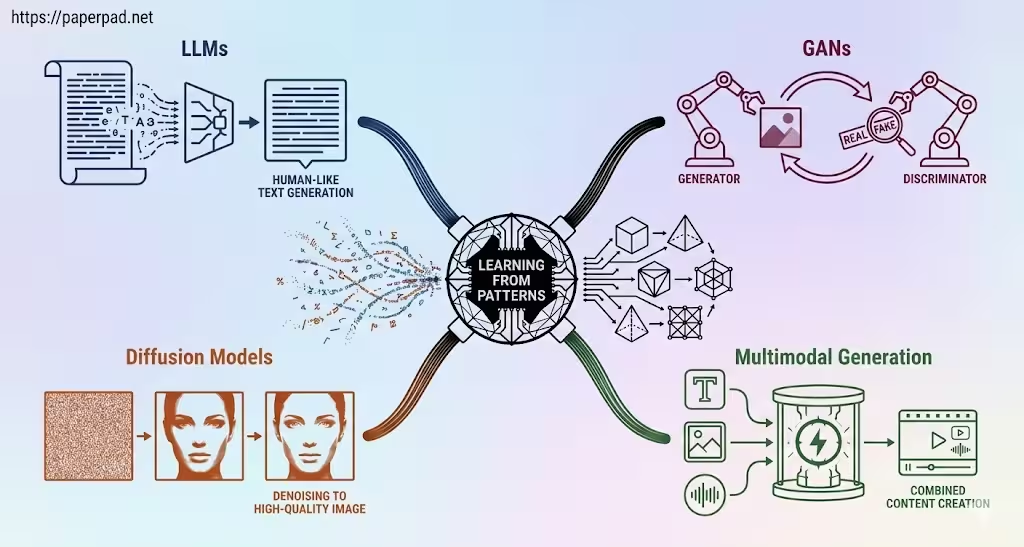
Generative AI infographic: LLMs, GANs, Diffusion, and Multimodal models on light gradient background with paperpad.net watermark.
Generative AI Explained: Explore 5 powerful ways AI creates new content, from LLMs to GANs and Diffusion Models. Understand how machines generate text, images, and more.

Quantum Computing & AI: 5 Powerful Reasons for a Future Partnership

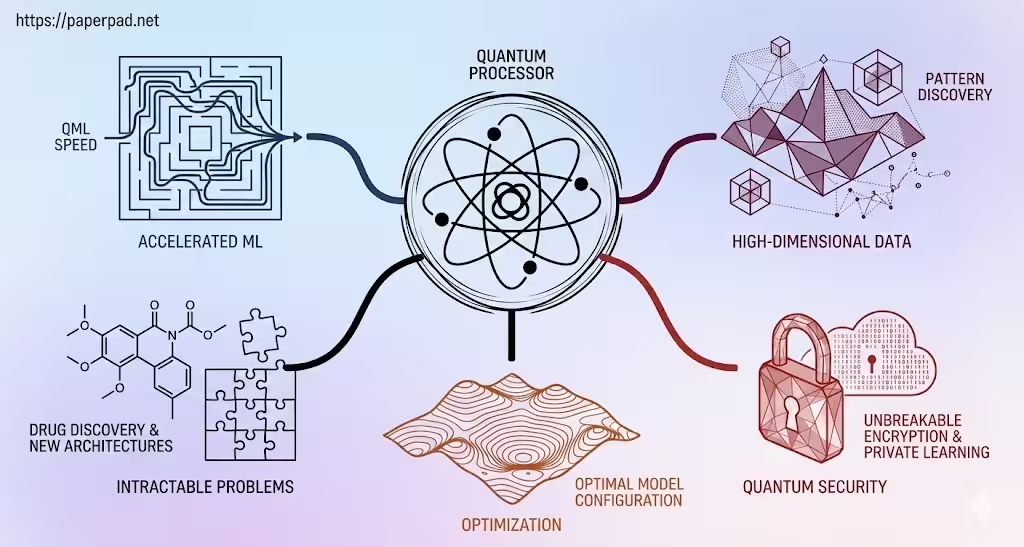
Quantum computing AI infographic: Central processor node connecting to ML, data, security, and optimization modules on a light gradient.
Quantum Computing & AI: Explore 5 powerful reasons why this future partnership could revolutionize AI. Understand how quantum computing can accelerate Machine Learning, data processing, and model optimization.

AI Hardware : 5 Powerful Chips Driving the AI

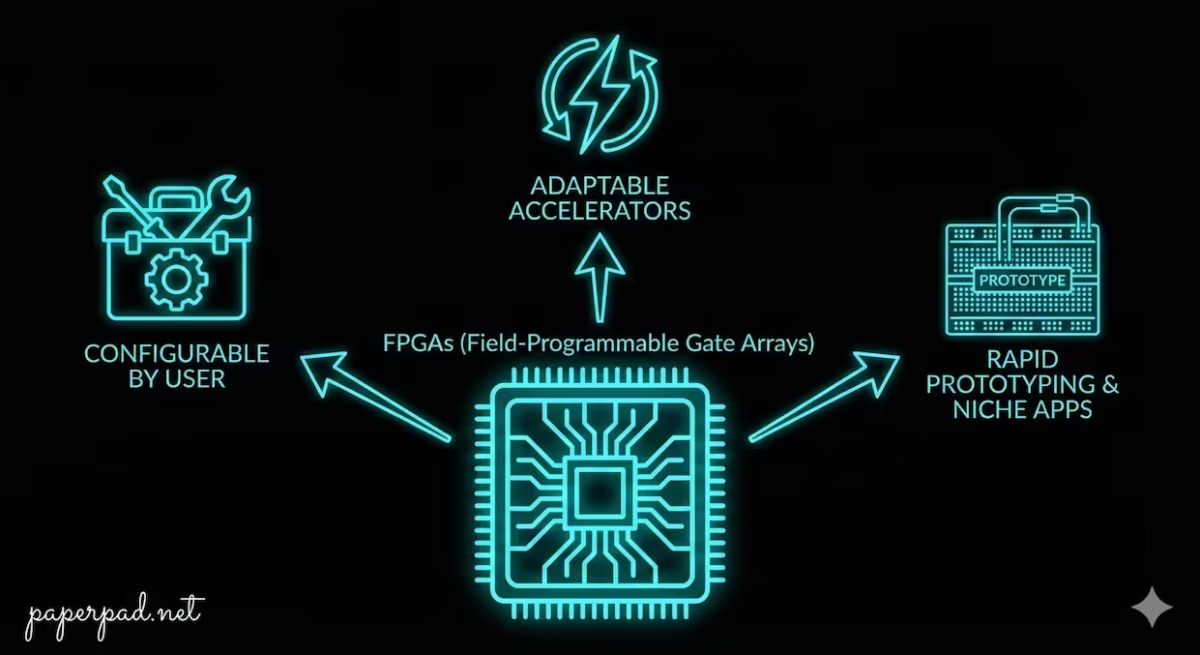
AI Hardware The FPGA's Role in Adaptability and Rapid Prototyping
The AI Revolution is fueled by specialized hardware, moving beyond traditional CPUs. GPUs (Graphics Processing Units) are key, excelling at parallel processing for Deep Learning. TPUs (Tensor Processing Units) are custom-built by Google specifically for AI workloads. These chips provide the immense computational power needed for training complex AI models. Understanding these "powerful chips" is crucial for appreciating AI's capabilities and scalability.

Cloud Computing in AI: 5 Powerful Ways Cloud Fuels AI’s Growth

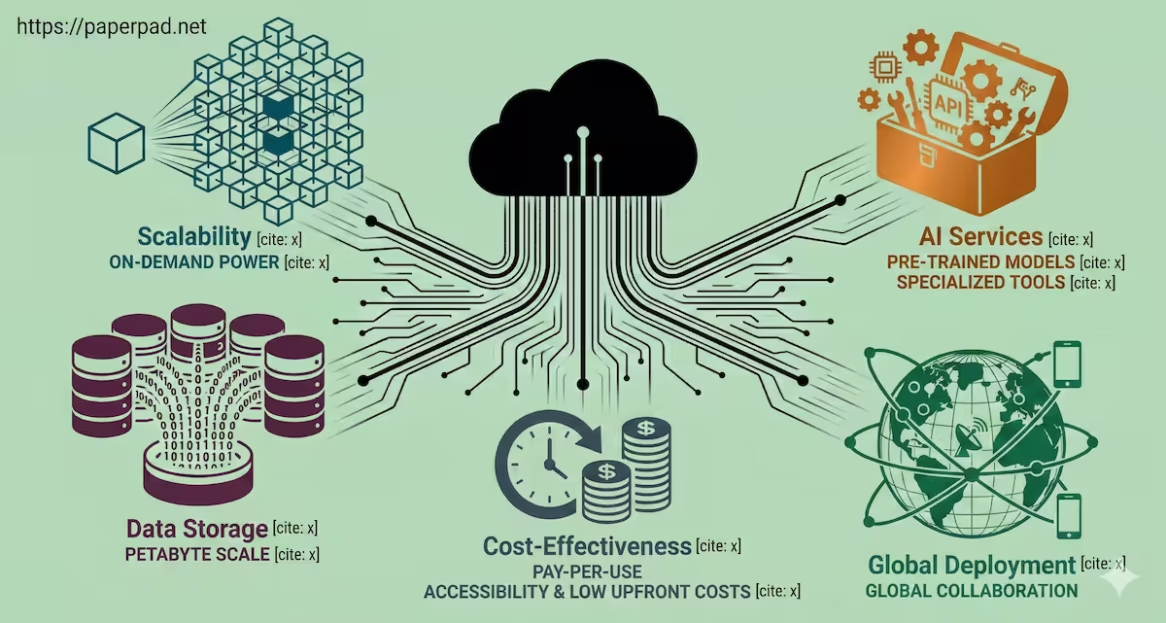
Cloud Computing in AI Cloud AI infographic on a light green background with 5 modules for scalability, services, storage, cost, and deployment.
Cloud Computing provides the massive computational power and flexible infrastructure essential for modern AI. It's crucial for training complex Deep Learning models and managing vast data sets. Key benefits include unmatched scalability, reduced cost, accessibility, and powerful tools. Cloud AI enables rapid experimentation, global deployment, and continuous innovation. Understanding Cloud AI is vital for unlocking AI's full potential and driving its widespread adoption.

What is Edge AI: 5 Powerful Reasons AI Moves to the Source

Infographic of Edge AI benefits: latency, reliability, efficiency, sustainability, and privacy on a sage green background.
Edge AI means running AI processing directly on local devices ("the edge") rather than in a central cloud server. It's crucial for speed, privacy, reliability, and efficiency in many real-world applications. Key benefits include reduced latency, lower cost, enhanced security, and improved autonomy. Edge AI is essential for devices with limited connectivity or strict data handling constraints. Understanding Edge AI is vital for designing intelligent systems that are responsive, secure, and sustainable.

Symbolic AI vs Connectionist AI

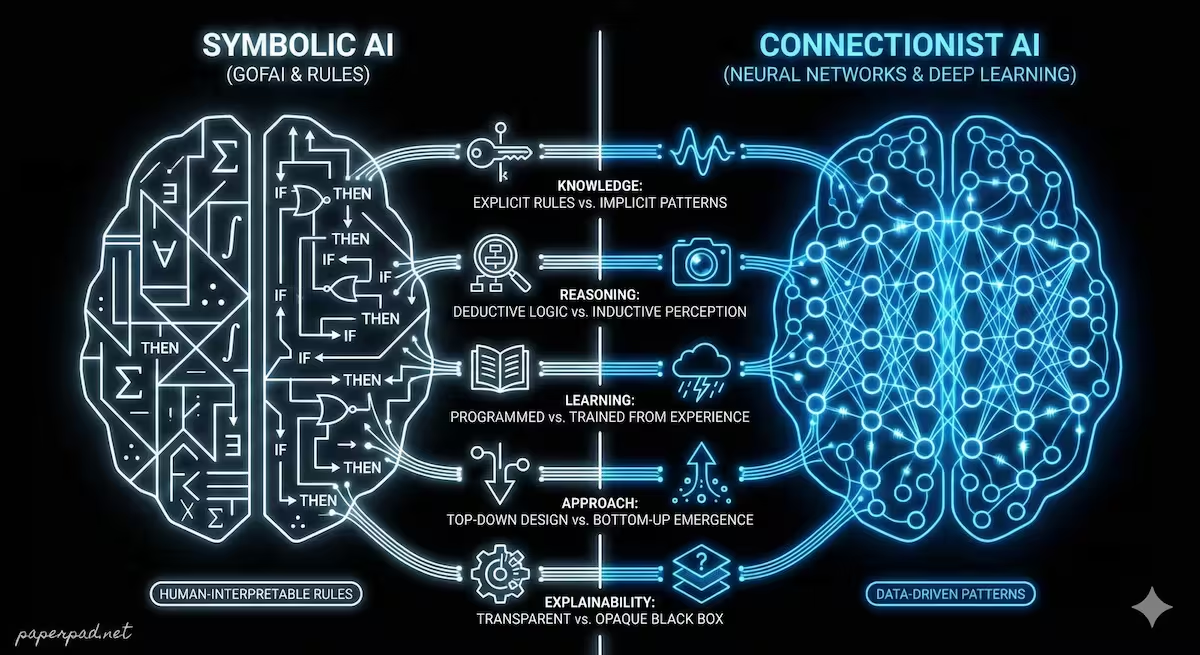
A brain split to compare 'SYMBOLIC AI (GOFAI & RULES)' and 'HUMAN-INTERPRETABLE RULES' (IF-THEN, logic gates) on the left vs. 'CONNECTIONIST AI (NEURAL NETWORKS & DEEP LEARNING)' and 'DATA-DRIVEN PATTERNS' (interconnected neural network) on the right. Five central comparison categories: KNOWLEDGE (Explicit Rules vs Implicit Patterns), REASONING (Deductive Logic vs Inductive Perception), LEARNING (Programmed vs Trained from Experience), APPROACH (Top-Down Design vs Bottom-Up Emergence), and EXPLAINABILITY (Transparent vs Opaque Black Box). 'paperpad.net' is at the bottom left.
Symbolic AI uses explicit rules and symbols to represent knowledge, like a detailed instruction manual. Connectionist AI (like neural networks) learns patterns from data, mimicking brain connections. Early AI focused on symbolic methods; modern AI is dominated by connectionist approaches, especially Deep Learning. Each path has distinct architectures, workflows, and strengths for different types of problems. Understanding these "two paths to machine intelligence" is crucial for appreciating AI's evolution and capabilities.

AI terminology Easy to understand

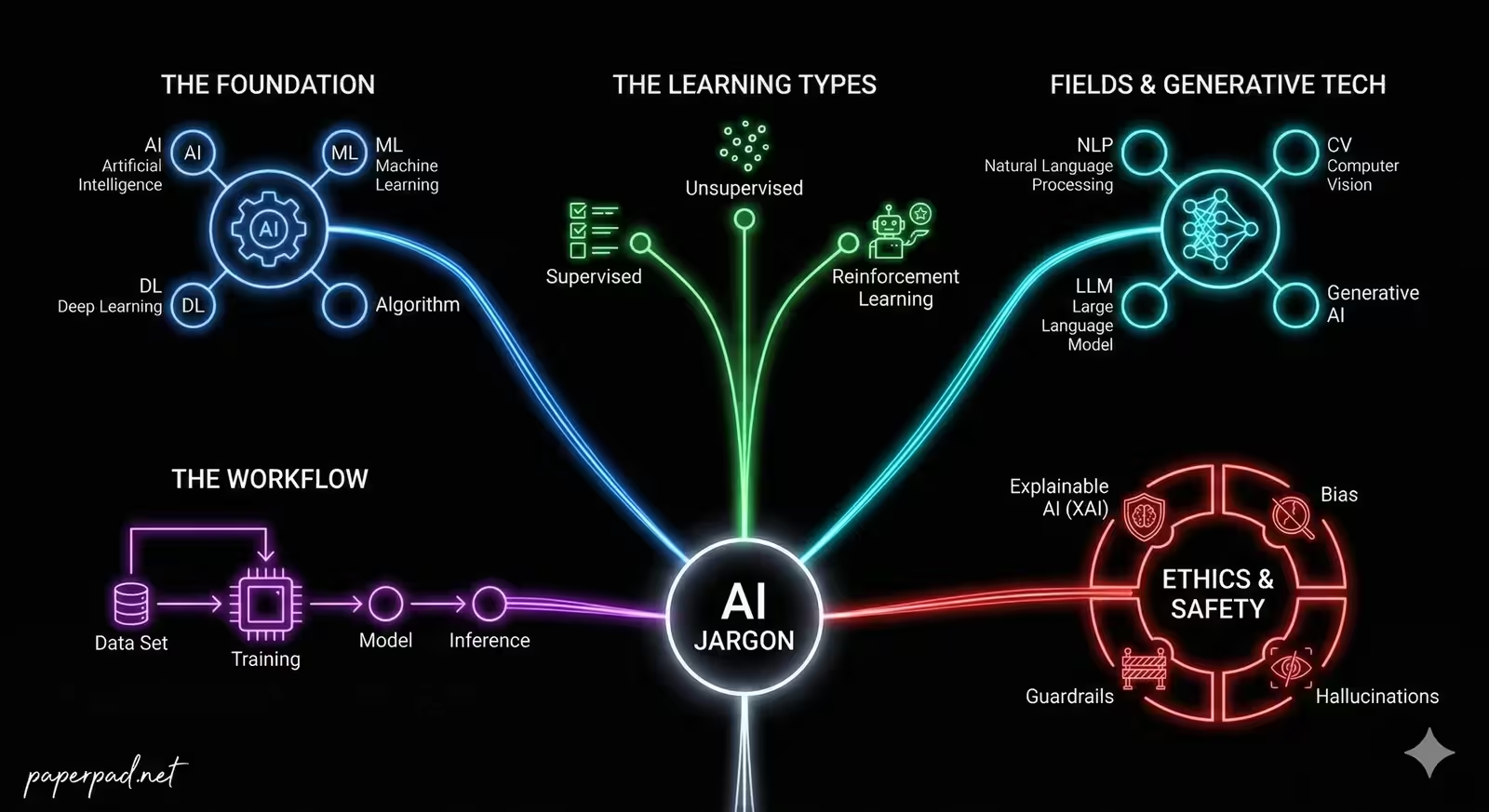
"infographic titled AI terminology: A Visual Map of the Artificial Intelligence Landscape' by paperpad.net. The design features a central 'AI JARGON' node with five branching categories shown in a neon-style aesthetic: The Foundation: Connecting AI, Machine Learning, Deep Learning, and Algorithm. The Learning Types: Featuring Supervised, Unsupervised, and Reinforcement Learning. Fields & Generative Tech: Highlighting NLP, Computer Vision, Large Language Models (LLM), and Generative AI. The Workflow: Illustrating the process flow from Data Set through Training, Model, and Inference. Ethics & Safety: Including Explainable AI (XAI), Bias, Guardrails, and Hallucinations."
AI terminology can be intimidating, but understanding key terms demystifies the field. This glossary provides simple, clear explanations for common AI concepts. From Algorithms to Deep Learning, knowing the language helps you engage with AI meaningfully. Understanding these terms is crucial for informed AI adoption and effective human-AI collaboration. Don't let confusing terms be a constraint to your AI literacy – get AI Jargon Decoded!

Computer Vision: 5 Powerful Ways AI Sees the World

"Infographic titled 'Digital Sight: 5 Ways Computer Vision Interprets Our World' by paperpad.net. The graphic features a central 'Cybernetic Eye' icon radiating five beams, each highlighting a specific computer vision task in a neon aesthetic: Image Classification: A box highlighting a cat with a '99% Cat' label. Object Detection: A street scene identifying a 'Car' and a 'Person' with bounding boxes. Facial Recognition: A digital scan of a face showing an 'ID: Verified' status. Scene & Activity Recognition: A graphic showing a person running in a park with labels 'Action: Sprinting' and 'Context: Park'. Object Segmentation: An outlined silhouette of a person riding a bicycle."
Computer Vision is the field of AI that enables computers to "see," interpret, and understand visual information from images and videos. It translates raw pixels into meaningful data, allowing AI to recognize objects, faces, and scenes. Deep Learning, especially convolutional neural networks, has revolutionized Computer Vision, enabling complex visual tasks. Applications range from self-driving cars to medical diagnosis and quality control in manufacturing. Understanding how Computer Vision works is crucial for developing AI that interacts intelligently with our visual world.

Natural Language Processing (NLP): 5 Best Ways Teaching Computers

"Infographic titled 'The 5 Stages of Natural Language Processing: Teaching Machines to Speak Human' by paperpad.net. The graphic illustrates a 5-step process in a neon-style flow chart: 1. Breaking Down (Tokenization & Parsing): Represented by text blocks being separated. 2. Understanding Meaning (Semantics & Entity Recognition): Depicted with a magnifying glass focusing on text entities. 3. Grasping Context (Contextual Embeddings): Shown as a network map of interconnected meanings. 4. Learning From Data (ML & Deep Learning): Represented by a glowing neural network structure. 5. Generating Language (NLG): Signified by an icon of a fountain pen writing, representing accurate AI response."
Natural Language Processing (NLP) is the field of AI that enables computers to understand, interpret, and generate human language. It bridges the gap between how humans communicate and how computers process information. NLP uses complex algorithms and Machine Learning to break down language into understandable components. Key applications include chatbots, translation, and sentiment analysis, helping computers grasp context. Understanding NLP is crucial for developing AI that interacts naturally and effectively with people.

AI vs Human Intelligence: 5 Big Differences Explained

"Infographic titled 'Human Intelligence vs. Artificial Intelligence: The 5 Fundamental Gaps' by paperpad.net. The graphic presents a side-by-side comparison of AI vs human intelligence across five key areas, using a neon-style aesthetic: Learning & Data Dependency: Contrasts human 'Experience-Based, Low Data Shot' learning against AI’s 'Pattern-Based, Big Data Hungry' approach. Processing Speed & Scale: Compares human 'Sequential, Limited Scope' processing with AI’s 'Parallel, Vast Scale' capabilities. Creativity & Intuition: Differentiates between human 'Original, Gut Feeling' creativity and AI’s 'Generative, Probabilistic' output. Common Sense & Contextual Understanding: Contrasts human 'Intuitive World Models' with AI’s 'Literal, Context-Brittle' nature. Conscious Emotion & Subjectivity: Highlights the difference between the human 'Sentient, Emotional Core' and AI’s 'Simulated, No Inner State'."
AI vs. Human Intelligence highlights fundamental differences in how each thinks, learns, and operates. AI excels at speed, data processing, and repetitive tasks, following precise algorithms. Human intelligence shines in creativity, common sense, emotional understanding, and complex context. While AI can mimic aspects of human thought, it lacks true consciousness or subjective experience. Understanding these differences is crucial for effective human-AI collaboration and responsible AI adoption.

Measuring AI Intelligence : 7 Ultimate Ways to Test AI

"Measuring AI Intelligence 'The Multi-Dimensional AI Diagnostic Hub' by paperpad.net. The design features a central 'MACHINE INTELLIGENCE CORE' represented by a brain icon, with six branching gauges that monitor various AI performance metrics in a neon-style aesthetic: Autonomy & Generalisation: A gauge showing 'COVERAGE AREA' next to a robot and globe icon. Turing Test: A gauge marked 'BASELINE' with human and AI icons. Task Specific Benchmarking: A gauge showing 'HIGH SCORE' accompanied by a checklist and stopwatch icon. Efficiency & Resource Consumption: A gauge monitoring 'ENERGY USAGE,' paired with chip, thermometer, and battery icons. Robustness & Adaptability: A gauge measuring 'STRUCTURAL INTEGRITY' next to a shield icon with outward-pointing arrows. Expandability & Interpretability: A gauge displaying 'CLARITY %' alongside an icon of a brain with an arrow. Creditability & Novelty: A gauge measuring 'UNIQUENESS' next to a lightbulb and fractal butterfly icon."
Measuring Machine Intelligence isn't straightforward; it's more complex than a simple "IQ test" for AI. Traditional methods like the Turing Test focus on human-like conversation, but often fall short. Modern approaches use diverse benchmarking tasks, evaluating AI's abilities in specific domains. Key metrics include performance, efficiency, adaptability, and even creativity. Understanding these methods is crucial for assessing true AI progress and its autonomy.

Explainable AI (XAI): 5 Reasons Understanding “Why” is Critical

Comparison of an opaque Black Box AI cube and a transparent Explainable AI cube with five key value pillars.
Explainable AI (XAI) helps us understand why an AI makes a particular decision, instead of just knowing what it decided. Many powerful AI models are "black boxes," making decisions without clear reasoning. Understanding the "why" is critical for building trust, detecting bias, ensuring safety, and meeting compliance. XAI methods allow us to peek inside these black boxes, providing transparency and auditability. Embracing XAI is vital for responsible AI adoption and effective governance.

Bias in AI: Strong 7 Reasons Fair Data Fuels Fair Algorithms

Bias in AI Infographic illustrating how input data is distorted by seven types of bias (historical, representation, etc.), resulting in jagged, biased AI output on a light background.
Bias in AI happens when AI systems make unfair or discriminatory decisions. It often originates from biased training data, reflecting societal prejudices or historical inequalities. Fair data is crucial because AI algorithms learn from what they're fed; biased data leads to biased outcomes. Recognizing and mitigating bias requires careful data governance, diverse teams, and continuous monitoring. Addressing bias is essential for building trustworthy AI, ensuring ethical compliance, and achieving equitable societal impact.

AI Ethics: 5 Pillars for Responsible AI

Five colored pillars representing AI ethics (Fairness, Transparency, Human-Centricity, Privacy, Safety) on a light blue background.
AI Ethics is about building AI systems that are fair, transparent, and beneficial for humanity. It's crucial because AI impacts everyone, from individual privacy to societal fairness. The 5 pillars include fairness, transparency, accountability, privacy, and safety/reliability. Implementing ethical guardrails involves proactive design, continuous monitoring, and human-in-the-loop oversight. Addressing AI ethics ensures public trust, reduces risks like bias and misuse, and promotes responsible AI adoption.

Elara and the Thinking Star

Parenting in Digital Era by PaperPad

Get Free Story Book for Kids

Get notified about new articles